
Sustainable Behaviour Change
Why Workplace Wellbeing Fails When Knowledge Doesn’t Turn Into Sustained Action
Most employees already know what supports better wellbeing.
They know exercise improves physical health and energy. They know sleep affects resilience and performance. They understand that stress management, recovery, connection and mental wellbeing matter.
The challenge is rarely knowledge. The much bigger challenge is turning knowledge into sustained action.
And then continuing that action despite busy workloads, stress, established routines, fluctuating motivation and everyday life. This is where habits become incredibly important.
Employees may leave a workplace wellbeing webinar, workshop or wellbeing day feeling motivated and inspired. But two weeks later, very little may have changed. Not because people do not care.
It is because awareness alone rarely creates sustainable behaviour change. For workplace wellbeing to make a lasting difference, positive actions need to be repeated often enough that they begin to feel normal.
The challenge is rarely knowledge. The much bigger challenge is turning knowledge into sustained action.
And then continuing that action despite busy workloads, stress, established routines, fluctuating motivation and everyday life. This is where habits become incredibly important.
Employees may leave a workplace wellbeing webinar, workshop or wellbeing day feeling motivated and inspired. But two weeks later, very little may have changed. Not because people do not care.
It is because awareness alone rarely creates sustainable behaviour change. For workplace wellbeing to make a lasting difference, positive actions need to be repeated often enough that they begin to feel normal.

Knowledge Does Not Automatically Create Behaviour Change
Workplace wellbeing programs often focus heavily on education.
Employees are given information about:

Physical activity
Mental wellbeing
Nutrition
Stress management
Mindfulness
Resilience
Healthy routines
This information can be useful.
But knowing what to do and consistently doing it are very different things.
Someone may know that daily movement would improve their health, but still struggle to exercise regularly.
Another employee may understand the benefits of taking short recovery breaks, but continue working through lunch because their existing routine is stronger than their intention.
This is the gap between awareness and behaviour.
And it is one of the biggest challenges in workplace wellbeing.
But knowing what to do and consistently doing it are very different things.
Someone may know that daily movement would improve their health, but still struggle to exercise regularly.
Another employee may understand the benefits of taking short recovery breaks, but continue working through lunch because their existing routine is stronger than their intention.
This is the gap between awareness and behaviour.
And it is one of the biggest challenges in workplace wellbeing.
.png)
From Cobwebs to Cables: How Wellbeing Habits Become Stronger
There is an old proverb:
“Habits are cobwebs at first, cables at last.”
“Habits are cobwebs at first, cables at last.”
It is a powerful way to think about employee wellbeing habits.
At the beginning, a new behaviour can feel fragile.
A short walk at lunch may be easily interrupted by a meeting.
A five-minute mindfulness break can disappear when the working day becomes busy.
A new exercise routine may be abandoned after a stressful week.
But repetition changes this.
Over time, repeated behaviours can become:
At the beginning, a new behaviour can feel fragile.
A short walk at lunch may be easily interrupted by a meeting.
A five-minute mindfulness break can disappear when the working day becomes busy.
A new exercise routine may be abandoned after a stressful week.
But repetition changes this.
Over time, repeated behaviours can become:
Stronger
More familiar
More automatic
Easier to begin
More resistant to disruption
This is where organisations can underestimate the real value of small workplace wellbeing habits.
The impact of one short walk or five-minute wellbeing activity may appear insignificant.
But the value is not contained in one action.
The value comes from repetition, accumulation and consistency over time.
But the value is not contained in one action.
The value comes from repetition, accumulation and consistency over time.
.png)
Why Small Wellbeing Habits Can Create Larger Outcomes
Small actions can influence much more than the behaviour itself.
For example, consistent daily movement may support:
Better energy
Improved mood
Greater confidence
Better sleep
Stress management
Healthier routines
Similarly, short daily mental wellbeing activities can help employees create regular moments of recovery, reflection or connection.
Over time, these behaviours can become part of the way someone naturally manages their wellbeing.
An employee stops thinking:
I should probably exercise.
And begins thinking:
Movement is simply something I do every day.
This shift is important because sustainable wellbeing is rarely created by one dramatic intervention.
It is more often built through small actions repeated consistently.
This idea closely connects with the behaviour-change principles explored in our article on what workplace wellbeing can learn from Atomic Habits.
Over time, these behaviours can become part of the way someone naturally manages their wellbeing.
An employee stops thinking:
I should probably exercise.
And begins thinking:
Movement is simply something I do every day.
This shift is important because sustainable wellbeing is rarely created by one dramatic intervention.
It is more often built through small actions repeated consistently.
This idea closely connects with the behaviour-change principles explored in our article on what workplace wellbeing can learn from Atomic Habits.
.png)
Why Participation Matters in Workplace Wellbeing
Participation is not simply a metric for measuring whether employees signed up.
It is a critical part of behaviour change.
Wellbeing only has the opportunity to create lasting impact when people participate often enough for new behaviours to become familiar.
Wellbeing only has the opportunity to create lasting impact when people participate often enough for new behaviours to become familiar.
This means organisations should think beyond:
How many employees registered?
And ask:
How many employees are still participating several weeks later?
How many employees registered?
And ask:
How many employees are still participating several weeks later?
Sustained participation matters because habits become easier to maintain when people experience:
Structure
Accountability
Social reinforcement
Consistency
Low friction
Encouragement from others
This is one reason team-based wellbeing programs can be particularly effective.
When participation becomes visible and socially supported, healthy behaviour can feel more normal.
A person is no longer trying to make a change alone.
They are part of a group doing it together.
When participation becomes visible and socially supported, healthy behaviour can feel more normal.
A person is no longer trying to make a change alone.
They are part of a group doing it together.
.png)

Social Support Helps Healthy Workplace Habits Stick
Behaviour does not happen in isolation.
The surrounding environment matters.
Employees are more likely to maintain positive behaviours when:
Colleagues participate too
Teams encourage one another
Progress is visible
Healthy behaviours feel accepted
Leaders support participation
Activities fit naturally into the working day
This is how workplace culture begins to influence individual habits.
One employee taking a short walking break may not change very much.
But an entire team normalising movement, recovery or mental wellbeing activities can gradually influence what feels normal across the workplace.
Over time, wellbeing becomes less of a separate initiative and more of an everyday behaviour.
But an entire team normalising movement, recovery or mental wellbeing activities can gradually influence what feels normal across the workplace.
Over time, wellbeing becomes less of a separate initiative and more of an everyday behaviour.
.png)
Sustainable Behaviour Change Starts With Achievable Consistency
At Wellbeing Challenge, this principle sits at the centre of our Workplace Habit System™.
Sustainable workplace wellbeing is rarely created through:
Intensity
Pressure
Extreme commitments
Occasional bursts of motivation
It is more often created through small daily actions that people can realistically repeat.
For physical wellbeing, that might mean:
15 minutes of intentional exercise
A short walk during the working day
Cycling
Stretching
A brief home workout
For mental wellbeing, it might mean:
Five minutes of mindfulness
Gratitude
Journaling
Time outdoors
Connection with a colleague
A short recovery break
The activity itself can remain flexible.
The important part is consistency.
Because wellbeing that fits into real life is far more likely to continue than wellbeing that depends on ideal circumstances.
The important part is consistency.
Because wellbeing that fits into real life is far more likely to continue than wellbeing that depends on ideal circumstances.
.png)
Why Low-Friction Wellbeing Programs Are Easier to Sustain
One of the biggest barriers to employee wellbeing participation is friction.
If a program requires too much time, planning or motivation, employees may struggle to continue when workloads increase.
This is why small actions can be so effective.
Compare:“Exercise for an hour every day.”
with:
“Complete 15 minutes of movement.”
One can feel difficult to fit into a busy schedule.
The other may feel achievable even on a demanding day.
Reducing friction makes it easier to begin.
And making it easier to begin increases the opportunity for repetition.
This principle also connects with the idea of behavioural absorption explored in What Watering a Plant Can Teach Us About Workplace Wellbeing.
People can only absorb so much change at once.
When workplace wellbeing programs ask employees to change too much, too quickly, participation can decline.
This is why small actions can be so effective.
Compare:“Exercise for an hour every day.”
with:
“Complete 15 minutes of movement.”
One can feel difficult to fit into a busy schedule.
The other may feel achievable even on a demanding day.
Reducing friction makes it easier to begin.
And making it easier to begin increases the opportunity for repetition.
This principle also connects with the idea of behavioural absorption explored in What Watering a Plant Can Teach Us About Workplace Wellbeing.
People can only absorb so much change at once.
When workplace wellbeing programs ask employees to change too much, too quickly, participation can decline.
Why Low-Friction Wellbeing Programs Are Easier to Sustain
One of the biggest barriers to employee wellbeing participation is friction.
If a program requires too much time, planning or motivation, employees may struggle to continue when workloads increase.
This is why small actions can be so effective.
Compare:“Exercise for an hour every day.”
with:
“Complete 15 minutes of movement.”
One can feel difficult to fit into a busy schedule.
The other may feel achievable even on a demanding day.
Reducing friction makes it easier to begin.
And making it easier to begin increases the opportunity for repetition.
This principle also connects with the idea of behavioural absorption explored in What Watering a Plant Can Teach Us About Workplace Wellbeing.
People can only absorb so much change at once.
When workplace wellbeing programs ask employees to change too much, too quickly, participation can decline.
This is why small actions can be so effective.
Compare:“Exercise for an hour every day.”
with:
“Complete 15 minutes of movement.”
One can feel difficult to fit into a busy schedule.
The other may feel achievable even on a demanding day.
Reducing friction makes it easier to begin.
And making it easier to begin increases the opportunity for repetition.
This principle also connects with the idea of behavioural absorption explored in What Watering a Plant Can Teach Us About Workplace Wellbeing.
People can only absorb so much change at once.
When workplace wellbeing programs ask employees to change too much, too quickly, participation can decline.
Why Low-Friction Wellbeing Programs Are Easier to Sustain
One of the biggest barriers to employee wellbeing participation is friction.
If a program requires too much time, planning or motivation, employees may struggle to continue when workloads increase.
This is why small actions can be so effective.
Compare:“Exercise for an hour every day.”
with:
“Complete 15 minutes of movement.”
One can feel difficult to fit into a busy schedule.
The other may feel achievable even on a demanding day.
Reducing friction makes it easier to begin.
And making it easier to begin increases the opportunity for repetition.
This principle also connects with the idea of behavioural absorption explored in What Watering a Plant Can Teach Us About Workplace Wellbeing.
People can only absorb so much change at once.
When workplace wellbeing programs ask employees to change too much, too quickly, participation can decline.
This is why small actions can be so effective.
Compare:“Exercise for an hour every day.”
with:
“Complete 15 minutes of movement.”
One can feel difficult to fit into a busy schedule.
The other may feel achievable even on a demanding day.
Reducing friction makes it easier to begin.
And making it easier to begin increases the opportunity for repetition.
This principle also connects with the idea of behavioural absorption explored in What Watering a Plant Can Teach Us About Workplace Wellbeing.
People can only absorb so much change at once.
When workplace wellbeing programs ask employees to change too much, too quickly, participation can decline.
Workplace Wellbeing Should Build Habits, Not Just Awareness
Awareness is valuable.
But awareness should be the beginning of workplace wellbeing, not the end.
The real opportunity is helping employees move through a progression:
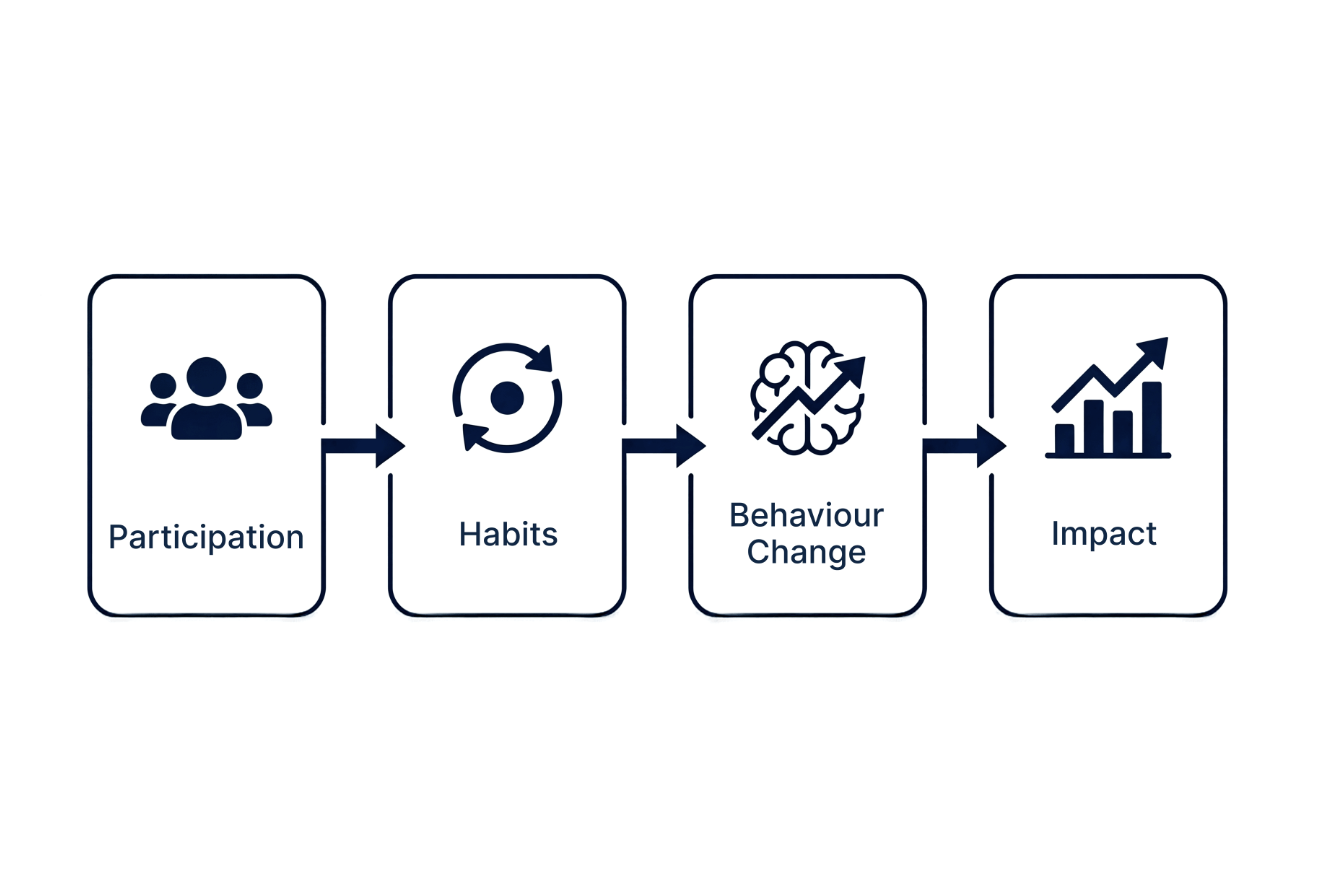
Knowledge → Action → Repetition → Habit → Sustainable wellbeing
This changes the way organisations should evaluate wellbeing programs.
The real opportunity is helping employees move through a progression:
Knowledge → Action → Repetition → Habit → Sustainable wellbeing
This changes the way organisations should evaluate wellbeing programs.
Instead of only asking:
Did employees attend?
Did they download the resource?
Did they enjoy the event?
It may be more useful to ask:
Are employees repeating the behaviour?
Is participation being sustained?
Is the action realistic enough to continue?
Are new wellbeing routines developing?
Are employees maintaining those behaviours afterwards?
These questions move workplace wellbeing from awareness towards behaviour change.

Why Low-Friction Wellbeing Programs Are Easier to Sustain
One of the biggest barriers to employee wellbeing participation is friction.
If a program requires too much time, planning or motivation, employees may struggle to continue when workloads increase.
This is why small actions can be so effective.
Compare:“Exercise for an hour every day.”
with:
“Complete 15 minutes of movement.”
One can feel difficult to fit into a busy schedule.
The other may feel achievable even on a demanding day.
Reducing friction makes it easier to begin.
And making it easier to begin increases the opportunity for repetition.
This principle also connects with the idea of behavioural absorption explored in What Watering a Plant Can Teach Us About Workplace Wellbeing.
People can only absorb so much change at once.
When workplace wellbeing programs ask employees to change too much, too quickly, participation can decline.
This is why small actions can be so effective.
Compare:“Exercise for an hour every day.”
with:
“Complete 15 minutes of movement.”
One can feel difficult to fit into a busy schedule.
The other may feel achievable even on a demanding day.
Reducing friction makes it easier to begin.
And making it easier to begin increases the opportunity for repetition.
This principle also connects with the idea of behavioural absorption explored in What Watering a Plant Can Teach Us About Workplace Wellbeing.
People can only absorb so much change at once.
When workplace wellbeing programs ask employees to change too much, too quickly, participation can decline.
Why Low-Friction Wellbeing Programs Are Easier to Sustain
One of the biggest barriers to employee wellbeing participation is friction.
If a program requires too much time, planning or motivation, employees may struggle to continue when workloads increase.
This is why small actions can be so effective.
Compare:“Exercise for an hour every day.”
with:
“Complete 15 minutes of movement.”
One can feel difficult to fit into a busy schedule.
The other may feel achievable even on a demanding day.
Reducing friction makes it easier to begin.
And making it easier to begin increases the opportunity for repetition.
This principle also connects with the idea of behavioural absorption explored in What Watering a Plant Can Teach Us About Workplace Wellbeing.
People can only absorb so much change at once.
When workplace wellbeing programs ask employees to change too much, too quickly, participation can decline.
This is why small actions can be so effective.
Compare:“Exercise for an hour every day.”
with:
“Complete 15 minutes of movement.”
One can feel difficult to fit into a busy schedule.
The other may feel achievable even on a demanding day.
Reducing friction makes it easier to begin.
And making it easier to begin increases the opportunity for repetition.
This principle also connects with the idea of behavioural absorption explored in What Watering a Plant Can Teach Us About Workplace Wellbeing.
People can only absorb so much change at once.
When workplace wellbeing programs ask employees to change too much, too quickly, participation can decline.
Sustainable Workplace Wellbeing Is Built Over Time
Most organisations already understand that employee wellbeing matters.
The bigger challenge is helping people sustain positive behaviours long enough for those behaviours to become:
Familiar
Easier
Natural
Automatic
Lasting
Because ultimately, people form habits.
And habits influence future behaviour.
The organisations creating the strongest long-term wellbeing outcomes may not necessarily be those offering the greatest number of initiatives.
They are often the organisations creating conditions where employees can repeatedly practise a small number of valuable behaviours.
Because sustainable workplace wellbeing is built through what people are able to do again tomorrow.
And the day after that.
And eventually, without needing to think about it at all.
And habits influence future behaviour.
The organisations creating the strongest long-term wellbeing outcomes may not necessarily be those offering the greatest number of initiatives.
They are often the organisations creating conditions where employees can repeatedly practise a small number of valuable behaviours.
Because sustainable workplace wellbeing is built through what people are able to do again tomorrow.
And the day after that.
And eventually, without needing to think about it at all.
Featured Blog Articles
Helping organisations turn wellbeing into lasting habits
What Workplace Wellbeing Can Learn From Atomic Habits
Most workplace wellbeing programs focus on motivation, but lasting behaviour change is best built through small daily habits repeated consistently over time.

What Watering A Plant Can Teach Us About Workplace Wellbeing
Sustainable workplace wellbeing often works like watering a plant - small, consistent actions absorbed gradually over time create far more lasting change than overwhelming people with too much at once.

The 20% Of Workplace Wellbeing Habits That Drive 80% Of Results
A small number of simple daily wellbeing habits can often create the majority of long-term improvements in energy, resilience, engagement, and workplace culture.