
Sustainable Behaviour Change
What Watering A Plant Can Teach Us About Workplace Wellbeing
Imagine watering a plant.
Give it too little water and it may struggle to grow. Pour an entire bucket onto it at once and much of the water may run off before the soil has time to absorb it. More is not always better.
Give it too little water and it may struggle to grow. Pour an entire bucket onto it at once and much of the water may run off before the soil has time to absorb it. More is not always better.
People can respond to change in a similar way.
There is a limit to how much new information, motivation, behavioural change, or wellbeing activity someone can realistically absorb at one time. Yet many workplace wellbeing programs unintentionally overlook this reality.
Employees may receive too many initiatives, too much information, and too many behavioural expectations at once.
The result is not always better employee wellbeing. Sometimes, it is disengagement.
There is a limit to how much new information, motivation, behavioural change, or wellbeing activity someone can realistically absorb at one time. Yet many workplace wellbeing programs unintentionally overlook this reality.
Employees may receive too many initiatives, too much information, and too many behavioural expectations at once.
The result is not always better employee wellbeing. Sometimes, it is disengagement.

The Absorption Rate Problem in Workplace Wellbeing
The “absorption rate” mental model offers a useful way to understand why some workplace wellbeing initiatives create sustainable behaviour change while others quickly lose momentum.
The principle is simple:
People, teams, and organisations can only absorb change at a manageable rate.
Beyond that point, providing more information or introducing more activities does not necessarily improve outcomes. In some cases, it can make participation feel harder.
This distinction matters because there is an important difference between introducing a wellbeing initiative and helping employees integrate healthier behaviours into everyday life.
Adoption Is Not the Same as Absorption
Adoption is often relatively easy.
Absorption takes longer.
For example:

Downloading a wellbeing app is adoption
Using it consistently enough to develop a daily habit is absorption
Registering for a workplace challenge is adoption
Continuing after the initial excitement fades is absorption
Attending a wellbeing webinar is adoption
Applying one of its lessons during a stressful working week is absorption
One creates exposure.
The other creates behavioural change.
In modern workplaces, many employees are already operating close to their cognitive and emotional limits. They are balancing deadlines, meetings, responsibilities outside work, constant notifications, and competing priorities.
Adding more wellbeing activity does not automatically make them feel more supported.
The other creates behavioural change.
In modern workplaces, many employees are already operating close to their cognitive and emotional limits. They are balancing deadlines, meetings, responsibilities outside work, constant notifications, and competing priorities.
Adding more wellbeing activity does not automatically make them feel more supported.
.png)
When Wellbeing Starts To Feel Like Another Task
Most workplace wellbeing programs begin with positive intentions.
Organisations want to give employees access to useful resources and practical opportunities to improve their physical and mental health.
However, the solution can become too overwhelming for real working life.
However, the solution can become too overwhelming for real working life.
An HR or People and Culture team might introduce:
Weekly wellbeing webinars
Mindfulness resources
Nutrition content
Fitness challenges
Resilience training
Wellbeing newsletters
Mental health tools
Social connection activities
Each initiative may offer value on its own.
Collectively, however, they may become another stream of information employees are expected to process.
This is particularly difficult when people are already managing:
Heavy workloads
Back-to-back meetings
Family responsibilities
Mental fatigue
Constant communication
Changing priorities
Limited time and energy
Instead of feeling supported, an employee may be thinking:
I know this is supposed to help me, but I honestly do not have the capacity for another thing right now.
I know this is supposed to help me, but I honestly do not have the capacity for another thing right now.
This is often where wellbeing fatigue begins.
It is not necessarily because employees do not value wellbeing. It may be because the program is asking them to absorb too much change at once.
It is not necessarily because employees do not value wellbeing. It may be because the program is asking them to absorb too much change at once.
Just as a plant cannot absorb unlimited water instantly, people cannot absorb unlimited wellbeing input instantly either.
.png)
Sustainable Behaviour Change Happens at a Manageable Pace
Micro-habit approaches can be effective because they respect the limits of time, energy, and attention.
They work with the realities of behaviour change rather than against them.
At Wellbeing Challenge, our Micro-Habit Methodology™ is intentionally built around small, manageable actions that people can realistically integrate into busy lives.
At Wellbeing Challenge, our Micro-Habit Methodology™ is intentionally built around small, manageable actions that people can realistically integrate into busy lives.
Because wellbeing that fits into real life is far more sustainable than wellbeing that only works under ideal conditions.
Examples include:
Fifteen minutes of intentional exercise
Five minutes of mindfulness or recovery
A short walk during the working day
A brief movement break between meetings
A simple daily wellbeing activity
A small moment of connection with a colleague
These small actions lower the barrier to participation.
They reduce overwhelm and give people time to become familiar with a new behaviour before adding more.
Wellbeing that fits into real life is usually more sustainable than wellbeing that only works under ideal conditions.
Sustainable workplace wellbeing starts with achievable consistency.
Sustainable workplace wellbeing starts with achievable consistency.
.png)
Why Small Changes Can Create Bigger Long-Term Outcomes
One of the most valuable aspects of small actions is that their effects can build over time.
As a behaviour is repeated, it may begin to:
Feel more familiar
Require less mental effort
Become part of an existing routine
Build confidence
Strengthen a sense of progress
Influence identity and self-perception
This is where genuine absorption begins.
A person may stop feeling as though they are “trying a workplace wellbeing program” and begin to see themselves as someone who:
A person may stop feeling as though they are “trying a workplace wellbeing program” and begin to see themselves as someone who:
Moves every day
Takes short wellbeing breaks
Prioritises recovery
Exercises consistently
Supports their colleagues
Makes healthier choices during the working week
That change is difficult to force.
It tends to develop through sustainable repetition.
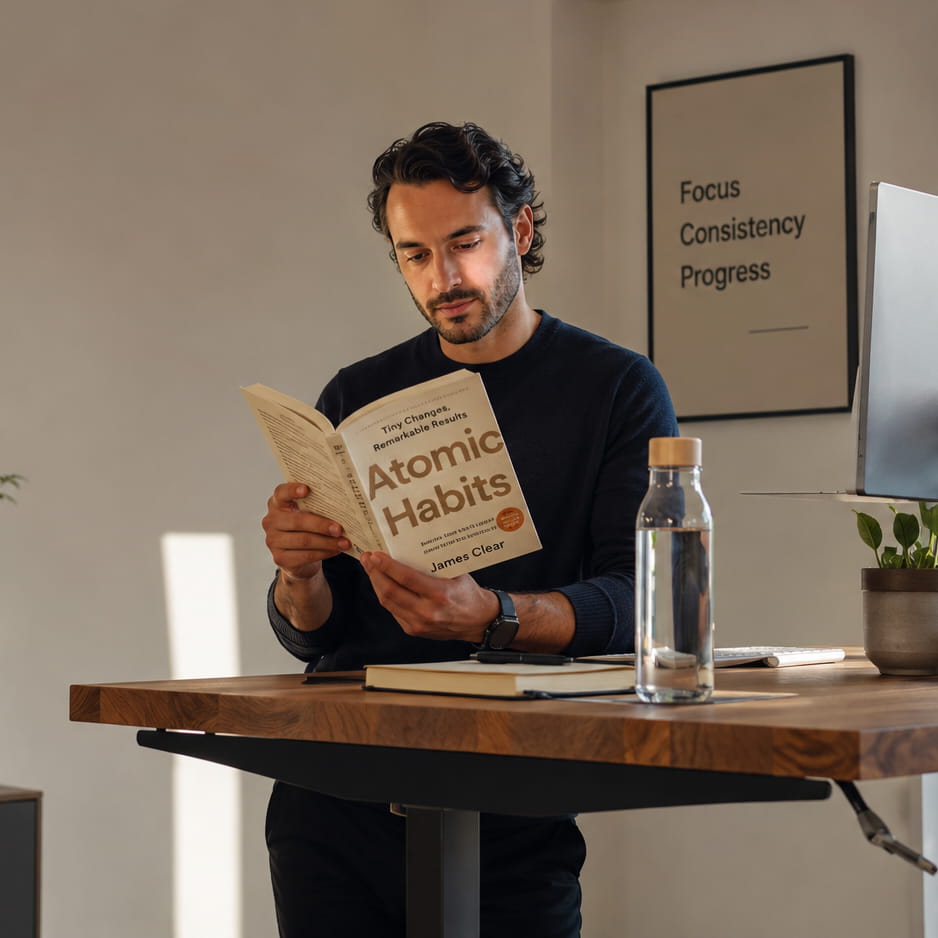
This closely connects with the identity-based behaviour change ideas explored in what workplace wellbeing can learn from Atomic Habits.
Lasting habits are rarely created through pressure or occasional bursts of motivation alone.
They are built through repeated evidence:
It tends to develop through sustainable repetition.
This closely connects with the identity-based behaviour change ideas explored in what workplace wellbeing can learn from Atomic Habits.
Lasting habits are rarely created through pressure or occasional bursts of motivation alone.
They are built through repeated evidence:
Small wins
Achievable participation
Consistent action
Gradual momentum
The focus becomes participation over perfection.
This is why the Wellbeing Challenge approach prioritises consistency rather than intensity.
Based on our internal program outcomes, this approach has contributed to:
This is why the Wellbeing Challenge approach prioritises consistency rather than intensity.
Based on our internal program outcomes, this approach has contributed to:
Average completion rates of approximately 80%
Strong engagement sustained across six-week programs
74% of participants reporting that they maintained their habits six months later
You can explore these outcomes in more detail through our workplace wellbeing case studies.
These results are not created by overwhelming people with change.
They are created by making change easier to absorb.
.png)
Teams Also Have an Absorption Rate
The absorption rate principle does not only apply to individuals.
Workplace cultures also change gradually.
Teams need time to:
Normalise wellbeing behaviours
Build trust and participation
Create shared accountability
Establish new routines
See leaders model healthy behaviour
A workplace may initially struggle to encourage employees to take walking breaks, participate in team activities, or complete short daily wellbeing habits.
At first, participation may feel unfamiliar or even slightly awkward.
Over time, as more people take part consistently, those behaviours can begin to feel normal rather than optional.
Over time, as more people take part consistently, those behaviours can begin to feel normal rather than optional.
This is how workplace culture often changes: gradually, socially, and through repetition.
Attempts to transform workplace wellbeing overnight may create resistance. A smaller and more consistent approach can allow participation to grow naturally.
Wellbeing becomes easier to absorb when it is:
Simple
Visible
Flexible
Socially supported
Low-pressure
Consistent
This is one reason organisations may return to Wellbeing Challenge year after year. The purpose is not to create a short period of extreme activity. It is to help teams build sustainable momentum.
That is one reason many organisations return to Wellbeing Challenge year after year, not because it creates short-term intensity, but because it helps create sustainable momentum.
That is one reason many organisations return to Wellbeing Challenge year after year, not because it creates short-term intensity, but because it helps create sustainable momentum.
.png)
Workplace Wellbeing Should Feel Sustainable, Not Overwhelming
Modern workplaces do not need more wellbeing complexity.
They need more realistic workplace wellbeing design.
Effective programs recognise that employees have:
Limited time
Fluctuating energy
Different motivations
Different starting points
Different physical abilities
Real workplace and personal pressures
A simgle rigid approach will not suit everyone.
Some employees may benefit from structure and accountability. Others may need flexibility, choice, or variety. The underlying wellbeing principle can remain consistent while allowing people to apply it in a way that fits their lives.
When wellbeing feels achievable, employees are more likely to begin.
When it remains achievable, they are more likely to continue and absord the change.
Some employees may benefit from structure and accountability. Others may need flexibility, choice, or variety. The underlying wellbeing principle can remain consistent while allowing people to apply it in a way that fits their lives.
When wellbeing feels achievable, employees are more likely to begin.
When it remains achievable, they are more likely to continue and absord the change.
.png)
Small Actions Still Count
A plant grows through consistent care over time.
Not through occasional flooding.
People are similar.
Small actions repeated consistently may be more powerful than ambitious changes that cannot be sustained.
Effective workplace wellbeing is not simply about providing more information, resources, or activities. It is about creating the conditions in which healthier behaviours can realistically take root.
That means reducing friction, respecting people’s capacity, and allowing new habits to develop at a manageable pace.
Sometimes, the most effective place to start is by making workplace wellbeing small enough to absorb.
Wxplore our workplace wellbeing case studies to see how achievable daily actions can support sustainable behaviour change.
Wxplore our workplace wellbeing case studies to see how achievable daily actions can support sustainable behaviour change.
Featured Blog Articles
Helping organisations turn wellbeing into lasting habits

The 20% Of Workplace Wellbeing Habits That Drive 80% Of Results
A small number of simple daily wellbeing habits can often create the majority of long-term improvements in energy, resilience, engagement, and workplace culture.

Why Workplace Wellbeing Fails When Knowledge Doesn’t Turn Into Sustained Action
Most employees already know what improves wellbeing - the real challenge is turning that knowledge into lasting behavioural change.
What Workplace Wellbeing Can Learn From Atomic Habits
Most workplace wellbeing programs focus on motivation, but lasting behaviour change is best built through small daily habits repeated consistently over time.